Friday, May 9, 2014

Nick's Picks

Some Grateful Dead shows I wouldn't have bothered to listen to without this article. Notably, he has an ear for eighties dead.


1/22/78, MacArthur Court, Eugene, Oreg.
1978 got a little sloppy, but this one is a monster. Start with “Terrapin,” or else “The Other One.” Listen for the “Close Encounters” theme prior to “St. Stephen.” “Not Fade Away,” often rote, shows some special snarl. Sounds like Garcia was abducted by aliens. (Listen here.)
1/15/79, Springfield Civic Center, Springfield, Mass.
The end of the Keith and Donna Godchaux era had its ups and downs, this night being no exception. But the way the “I Need a Miracle” crashes into “Shakedown Street” is unique and stately. It sounds almost (banish the thought) pre-meditated. The pretty, chimey jam out of “Drums” into the so-called “Playin Reprise” ends with warp-speed Garcia fingerwork that boggles the mind, until you hear the band careen into “Casey Jones,” and then it all makes pharmacological sense. (Listen here.)
11/30/80, Fox Theater, Atlanta, Ga.
An old cult favorite. The whole second set, courtesy of Dr. Bob Wagner. The “Scarlet Begonias”-“Fire on the Mountain” may be the main attraction, but the “Playin’ ” jam is a headlong fever dream—not for the faint of ear. The way “The Wheel” comes out of the “Space” is real purty, though, as is the weepy, deliberate “Ship of Fools.” (Listen here.)
8/29/83, Silva Hall, Hult Center, Eugene, Oreg.
In the early- to mid-eighties, there were marquee nights and grim ones. You could build a rescue raft out of a dozen sturdy “China”-“Rider”s. I just adopted this version, even though no one else I know really seems to know it. The band plays faster than ever, tight and coke-y bombastic bluegrass. The recording is rough (this is why God made equalizers, or other bands), but Garcia blazes. You’ll shed a few pounds. (Listen here.)
7/13/84, Greek Theatre, Berkeley, Calif.
The “Scarlet”-“Touch of Grey”-“Fire” (this was before “Touch of Grey” had been recorded; it’s brisker here) is a beloved oddity. Garcia, often AWOL in 1984, comes to play. The synthy keyboards may frighten off “Alligator” fans, but let’s not forget this was the era of Wham! There’s also another beautiful “Space”-“Wheel” (it’s happenstance, the combo is not a fetish of mine), a death-shrouded “Stella Blue,” a floor-bouncing “Sugar Magnolia,” and then a rare thing for this era, “Dark Star,” as an encore—in the lore, a shooting star blessed the breakout. You’re not in 1969 anymore, but still, a taste of the old magic. With apologies to 10/12/84. (Listen here.)

Monday, April 21, 2014

Here I Was

at the end of America...no more land...and nowhere was nowhere to go but back.

--Jack Kerouac

Friday, April 18, 2014

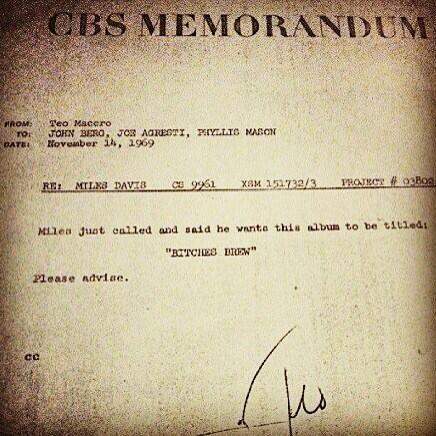
Embedded image permalink

Miles Davis (Second Great Quintet '64-'68)

Gonna dive into these albums. Transitional period. Post-bop to fusion.

E.S.P. (1965)
Miles Smiles (1967)
Sorcerer (1967)
Nefertiti (1968)
Miles In The Sky (1968)
Filles de Killimanjaro (1969)

Thursday, April 17, 2014

For No Good Reason

Slash sighting at the Landmark. Watched For No Good Reason -- a doc on painter Ralph Steadman, conspirator with Hunter S. Thompson.

I need to check out Rembradt's self-portraits. He painted his entire life, stage by stage.

Monday, April 14, 2014

Blood Red Lunar Eclipse.

Fortune

"You and your wife wife will be happy in your life together."

(the regular order of hot & sour soup with egg rolls.)

Grateful Dead -- Europe 1972 Tour

It's April. In the spring of '72 the Grateful Dead crossed the pond for a European tour.  One of their best. Concert halls and four hour performances. The tour bridged the gap. The end of Pigpen, and the ushering in of Donna Jean & Keith.

Bozos and Bolos.

Sing Me Back Home


Dark Star


Saturday, April 5, 2014

El Cholo

Bustling on a Friday night. Upstairs corner booth. Ceviche tostadas. Too soon for the green corn tamales (May-Oct).
Skipper Chug Laguna (@DoctorDogballs)
local minor league baseball team has a $10 all you can drink beer night & I'm going to show them that marketing decisions have consequences

Wednesday, April 2, 2014

Lay The Favorite

I can't believe that Stephen Frears really directed that movie?!? I think what happened was Frears (a degen) got down big, and was able to settle his debts by agreeing to direct the film. That's the only explanation for his involvement in this turd.

Other turds:
*Rebecca Hall. The worst actress alive with this performance. She should have burned the dailies.
*Catherine-Zeta Jones. Didn't even realize she was in the movie 'til the end credits. Thought it was Teri Hatcher with bad plastic surgery-wannabe.

I couldn't believe that Vince Vaughn pops up in the movie. What happened? This really is the same Stephen Frears who directed The Grifters, The Hit, The Queen, etc...

Tuesday, April 1, 2014

Dark Star. 5/14/74 -- C. Mike Hamad


Grateful Dead (Missoula 5.14.74)

Dave's Picks Volume 9 features a 1974 Grateful Dead concert played in Montana.

Set 1
Bertha
Me & My Uncle
Loser
Black Throated Wind
Scarlet Begonias
It Must Have Been The Roses
Jack Straw
Tennessee Jed
Mexicali Blues
Deal
Big River
Brown-Eyed Woman
Playing In The Band

Set 2
U.S. Blues
El Paso
Row Jimmy
Weather Report Suite
Dark Star ->
China Doll
Promised Land
Not Fade Away
Going Down The Road Feeling Bad

Encore
One More Saturday Night

Wall of Sound '74


Monday, March 31, 2014

Opening Day

Take Me Out to the Ball Game from '98 if my memory holds true.


Sunday, March 30, 2014

Martini Time

Morning hike Paseo Miramar. Queen's breakfast at Ye Olde King's Head. Kentucky pulls out victory versus Michigan in elite 8. Cooked spring sunday dinner surf & turf.  Dark chocolate, strawberries, and almonds for dessert.

Keep the gin martini's rolling. A few olives. Two martini strong.

Saturday, March 29, 2014

Lin's

Hot & Sour soup. And a fortune...

":) You love life very much. :)"

Friday, March 28, 2014

To Duncan

I searched this long to find you, and I'm not gonna let go now.


Tuesday, March 25, 2014

Taking a late-night walk I woke up from a half-sleep dream crosseyed. frantic. i couldn't correct it.

You Stand By Me

When I'm in trouble, you stand by me
When I see double, you stand by me
You take my side, against those who lied
You take my side, gimme back my pride

When I been losing, you stand by me
When I been boozin', you stand by me
You take my side, against those who lied
You take my side, gimme back my pride

I suppose I could make it all my own
I know I'd arrive all skin and all bone
You carried me, carried me, carried me
You carried me home

When I'm crying
You stand by me
When I am dying
You stand by me.


Photo

Monday, March 24, 2014

True Detective (Finale)

Finished it late night. Overall, it is good television. Eight hours of story telling.  Flaws, oh yes. But also grandness (though ambitions fall short) and haunting, lasting images.

These guys from The Atlantic wrap it all up -- the good and the bad.

True Detective: 2666 is up next.

Farewell Transmission

The whole place is dark
Every light on this side of the town
Suddenly it all went down
Now we'll all be brothers of...
The fossil fire of the sun
Now we will all be sisters of...
The fossil blood of the moon

Someone must have set 'em up
Now they'll be working in the cold, grey rock
Now they'll be working in the hot mill steam
Now they'll be working in the concrete.
In the sirens and the silences now
All the great, set-up hearts
All at once, start to beat.

After tonight, if you don't want this to be
A secret out of the past
I will resurrect it
I'll have a good go at it
I'll streak his blood across my beak
Dust my feathers with his ash
Feel his ghost breathing down my back

I will try
And know whatever I try
I will be gone, but not forever

I will try
And know whatever I try
I will be gone, but not forever
 
The real truth about it is
No one gets it right
The real truth about it is
We're all supposed to try

There ain't no end to the sands I been trying to cross
The real truth about it is
My kind of life's no better off
If it's got the map, or if it's lost

We will try
And know whatever we try
We will be gone, but not forever
Come on, let's try
And know whatever we try
We will be gone, but not forever

The real truth about it is
There ain't no end to the desert I'll cross
I've really known it all along
Mama, here comes midnight with the dead moon in its jaws
Must be the big star about to fall

Long, dark blues
The will-o'-the-wisp
 
Long, dark blues
The big star is falling
 
Long, dark blues
Through the static and distance
 
Long, dark blues
A farewell transmission
 
Long, dark blues
Listen...
 
Jason Molina died on March 16, 2013, in Indianapolis as a result of alcohol abuse-related organ failure. He was 39 
 
Henry Owings, a friend of the musician, published an article on his online music magazine Chunklet  that said Molina had struggled with alcoholism for most of the decade leading up to his death. Owings also wrote that Molina had "cashed out on Saturday night in Indianapolis with nothing but a cell phone in his pocket with only his grandmother’s number on it."
 
Molina was married to Darcie Schoenman Molina. They were estranged at the time of his death, and the couple had no children.


E. Hemingway

Hemingway was raised in Oak Park, Illinois. After high school he reported for a few months for The Kansas City Star, before leaving for the Italian front  to enlist with the World War I ambulance drivers. In 1918, he was seriously wounded and returned home. His wartime experiences formed the basis for his novel A Farewell to Arms.

In 1921, he married Hadley Richardson, the first of his four wives. The couple moved to Paris, where he worked as a foreign correspondent and fell under the influence of the modernist writers and artists of the 1920s "Lost Generation" expatriate community. The Sun Also Rises was published in 1926.

After his 1927 divorce from Hadley Richardson, Hemingway married Pauline Pfeiffer; they divorced after he returned from the Spanish Civil War where he had been a journalist, and after which he wrote For Whom the Bell Tolls.

Martha Gellhorn became his third wife in 1940; they separated when he met Mary Welsh in London during World War II. He was present at the Normandy Landings and the liberation of Paris.

Shortly after the publication of The Old Man and the Sea in 1952, Hemingway went on safari to Africa, where he was almost killed in two successive plane crashes that left him in pain or ill health for much of the rest of his life.

Hemingway had permanent residences in Key West, Florida (1930s) and Cuba (1940s and 1950s), and in 1959, he bought a house in Ketchum, Idaho, where he committed suicide in the summer of 1961.

Sunday, March 23, 2014

Hoosiers

It's March. Back in Indiana the film is a seasonal rite. Tonight it was clear that the film is all about second chances. Characters all having another chance to make right.

Then Goodfellas was playing on IFC. First time in a long while. Still know it by heart. But on this viewing my eyes saw anew that Henry & Karen have the only lasting, unconditional relationship in the film. Money, greed, paranoia,  tears apart every friendship offered. Betrayal and violence. There's no trust. No safety. Except for Henry & Karen who remain in good times and bad.

Swingers was a brief nightcap. I didn't fall in love with the film until living in Los Angeles.

All Tarantino does is rip off Scorsese.

NCAA Day 3 (Saturday)

One of the most profitable days I've had betting on the tournament ever. 

Yet I feel like I lost.

Saturday, March 22, 2014

Now Playing at the Nuart

Now Playing at the Nuart Nuart Note: Nymphomaniac  contains graphic depictions of sexuality to a degree unprecedented in a mainstream featured film. NO ONE UNDER 18 WILL BE ADMITTED.

Saturday Morning


NCAA Day 2 (Friday)

A long day. Duke loses early to Mercer. Oklahoma State loses to Gonzaga. UCLA beats Tulsa in the late game. When all is said and done -- not quite break even.

Friday Night

As I go to bed, I can't keep from shivering.


Wednesday, March 12, 2014


Sawtelle

My favorite lunch in Los Angeles.

Tsujita. A bowl of ramen in which you dip the cold noodles into the hearty broth. hard boiled egg. pork.
I venture to try other ramen places, but once I'm done I just think -- I should've stuck with Tsujita. A few dollars pricey but worth it. They know it.

Then top it off with a cream-filled pastry from Beard Papa. It's crack.

Wednesday, March 5, 2014

Sunshine

Back in Santa Monica. Beautiful morning. Go run ("bathtub gin").
Power breakfast chicken breast/egg whites. pharmacy. shell station. car wash.

Friday, February 28, 2014

Favorite Films of 2013


My Top Five:
(note: what they share in common is I happened to see all them all at the right time.)

1. Inside Llewyn Davis
2. Drinking Buddies
3. The Counselor (Extended Cut)
4. Frances Ha
5. Nebraska

Five more I liked:
Dallas Buyers' Club
Enough Said (James Gandolfini. favorite performance of the year. no flash, no illness, no fame. just a
                      regular guy -- the toughest role to play)
I'm So Excited (valencia cocktail, please)
The Act of Killing (sequence of the year: up on the roof. gagging, coughing, dry heaving. the inner
                       manifested physically.)
The Wolf of Wall Street


Sunday, February 23, 2014

Rusty Bucket

the sun's going down, the cold's creeping in. I take my walk. the afternoon had disappeared. waves. it's february here.
my dad is slouched in his kitchen table chair. liam neeson talks about natasha on 60 minutes. i drink a gin & tonic. he already had his. it's past the time for dinner.
go to rusty bucket. few patrons at the bar. we sit at a booth. no one else around. texas chilli and a salad. white wine. the waitress cleans up as we eat. it's a late sunday night.

kerouac was 47 years old when he died living at his mom's house in florida. either '68 or '69. he was taking care of her or maybe she was taking care of him. no one seems to remember that. on the road was published when he was 35. he was already divorced by 25. the film replaces the opening line of  "i first met dean not long after my wife and I had split up," with " i first met Dean not long after my father died."
his follow up to on the road was big sur.

big sur shows kerouac suffering from his own fame and lamenting the fact that he’s no longer young.  "All over America high school and college kids thinking ‘Jack Kerouac is 26 years old and on the road all the time hitchhiking’ while there I am almost 40 years old, bored and jaded.”  kerouac wanders from a cabin in Big Sur to San Francisco and back again. his headspace builds to an  alcohol-induced nervous breakdown,  and ends with the near distant hope for healing. though Kerouac behaves much the same way as he did in on the road, he doesn’t feel the same way:  death and drinking. youth and old age.

Someone brought up kerouac to me in reference to their saturday night. i folded up my dad's walker and closed the passenger side door. the parking lot was empty. we had a good spot.

time to pour myself a whiskey.

Saturday, February 22, 2014

Tiger Lily

Saturday night. Chinese restaurant next door to the Rusty Bucket. Felt as much Nebraska as Indianapolis. I'm in a hooded sweatshirt. The 18 year old waitress can't advise or touch the wine. She hates kimchi. So I order seafood ramen, and yes it's ramen right out of the 25 cent package. My mistake. Not in Los Angeles.

Dad orders cashew chicken. I see if he remembers anything of Ava Gardner. She was "sultry. More sexy, than an actress." He couldn't place a film.

Found two old photo albums back home.

Friday, February 21, 2014

Afternoon

After a sandwich lunch, I've hit the bed gazing out the window in my brother's room. It's February in Indianapolis. Thinking about drifting in warm waters. Baja California waters. I'm eating rice out of a small styrofoam container. I crack into something.. It's my fork. The feeling of accidentally biting down on your fork. The metallic pain. I don't stop. I continue biting down on it even though I see one of the tines sits at the bottom of the container.

I wake up. My jaw is numb. The taste of the fork remains.

James Ellroy

Fuego.

I hate hipsters, I hate liberals, I hate rock’n’rollers, I hate the counter-culture, I hate movie people. I want to go somewhere quiet, peaceful and decorous, and be radical in my mind. I have fatuous American ideas about Britain. I want to go to the moors. I want to buy a shotgun from Purdey for a lot of money, but I understand it’s tough to buy a gun – you can’t just walk in and say, “I’m an American, give me that gun.” British people are the best readers. They speak the same language, but view the material as foreigners. There’s no class distinction for readers there. They ask the best questions and you can talk to them afterwards and go to an Indian restaurant.

Thursday, February 20, 2014


Bobby Charles

BobbyCharles
As a teenager, Bobby Charles—né Robert Charles Guidry in Abbeville, Louisiana—cut several swampy, R&B-based sides for Chess and Imperial, including “See You Later, Alligator,” which the Texan Bill Haley would hit with in 1956. Then in 1960 and ‘61, Charles scored two more top-ten hits as a writer, giving the immortal “Walkin’ to New Orleans” to Fats Domino and “(I Don’t Know Why I  Love You) But I Do” to Clarence “Frogman” Henry. Though he found some touring success with R&B audiences in the late ‘50s (Leonard Chess is rumored to have booked Charles on a tour of the chitlin circuit, not having realized that his new signee was a white Cajun), he never broke through as a performer; after releasing a few barely-noticed records in the early ‘60s, he disappeared, and after being arrested for possession in Nashville in 1971, wound his way to Woodstock. He’d never heard of the festival; he just liked the name.
Though his best-known songs had by that time largely faded from the public consciousness, it was a good time to be a Louisiana musician with a rock ‘n’ roll bent. Doug Kershaw had just released The Cajun Way and was palling around with Johnny Cash, and The Band were popularizing a hybridized form of rural rock that was deeply indebted to Louisiana roots (they’d open 1973’s Moondog Matinee with a cover of another “Frogman” song, “Ain’t Got No Home”). Dr. John was helping Mick Jagger and Eric Clapton get their ya yas out. Out in L.A., upstart singer-songwriter Randy Newman was beginning to twine piano lines worthy of Professor Longhair through his sophisticated art-pop. It wasn’t exactly the British Invasion—invasions never having been Louisiana’s style—but it’s the closest mainstream rock has ever gotten to full-on gris-gris.
Bobby_CharlesSo it’s not terribly surprising that Charles wound up befriending The Band, or that they’d be so taken by the 33-year-old’s songs that they’d all (with the exception of Robbie Robertson) wind up playing on Bobby Charles. You don’t need to read the liner notes to know that Rick Danko had a heavy hand in the production; the ten tracks hang together with the same kind of slack grace that Danko brought to his bass, and his trademark style—more rhythmic bumping than sustained playing—forms a nice counterpoint to Charles’ seasoned vocals. Gone is the velvet-trimmed voice that tricked Leonard Chess fifteen years prior. Charles’ voice here is easy, relaxed, and he sings his songs with a kind of loose, Kristoffersonian authority: “It’s all small-town talk,” he consoles his live-in lover on the album’s lone single, “You know how people are.” Later, he and his boys will slowly turn up the heat on the poor-man lament “All the Money” till it rolls into a boil of trilling sax, splatting trumpet, and Charles jokingly complaining “He got all the power, and he won’t give me none!” These aren’t great lyrics in the way that Kristofferson’s (or even Robbie Robertson’s) are—Charles isn’t shooting for posterity here—but they’re great in the same way that “A wop bop a loo bop” is a great line, or, if you prefer, “Tipitina, tra-la-la.” It’s not so much what Charles is singing as it is the general attitude, the kind of easiness afforded by failure and foiled expectations that can animate a couplet as banal as “You got a long face/Your head’s in the wrong place.” Words and music slide out like honey.
That easiness—or maybe joy—is the record’s animating spirit. There’s no high drama, really, no attempts to reanimate Confederate corpses, no real grappling with moral or spiritual uncertainties; though the two are close stylistic cousins, Bobby Charles is the anti-On the Beach. You can practically hear the creak in Charles’ chair as he leans back in the opening moments of “Street People,” setting the record’s tone with a lazy little up-and-down guitar line and a shake of rhythm. It’s also the major difference between Charles and his Louisiana contemporaries: He lacks the alienating persona of Dr. John (who appears here) and the high-minded aspirations of Newman, and his apparent ambivalence toward mainstream success means that he has far less to prove than Kershaw. You can hear echoes of Fess’ big-handed piano playing in the opening moments of “I’m That Way” and “Long Face,” and “All the Money”’s aforementioned raveup could shut down the Maple Leaf, but Charles is just as happy to croon a lovestruck invitation over a Ben Keith pedal-steel line in “Let Yourself Go.” It’s a Louisiana record, both in spirit and in style, but it’s far less interested in that fact than just about any other Louisiana record of the era that I can think of.
Charles eventually moved home to Holly Beach, on the Gulf Coast. He lived a quiet life there, receiving Neil Young, Bob Dylan, and Willie Nelson as guests and emerging with the occasional album. Like Alex Chilton, who lived a couple of hundred miles down the road in New Orleans, he remained in relative obscurity, and maybe contentedly so, a onetime casualty of the hitmaking machine living off of his old royalties. As with all those Big Star records, you can’t call Bobby Charles a masterpiece, because that would freight it with ambitions far greater than it ever sets for itself. But you can call it perfect

Monday, February 17, 2014

President's Day

Saw Philomena at the Landmark in the afternoon. The lion's den for this Stephen Frears film. It's fine. Meh.

Later was invited to watch The Bachelor with Kat, Julia, & Tristan. First time for The Bachelor. It's fine. Meh.

A good President's Day.

Saturday, February 15, 2014

Dive Bars

L.A. City in the smog. city in the snow. don't you wish that you could be there too.

I fondly remember the Common Share in Adams Morgan during my time in D.C. These bars aren't in that league of that dive (and some are not dives -- Ye Olde Rustic Inn) but at least I've been to almost all these on the list and they are my go-too-bars here. The Speakeasy on Pico is a no brainer if their prices were half as much.

I do miss the joker. And the best bar in L.A. is still the lost and found.

hank's and smog cutter.

Wednesday, February 12, 2014

I'm Reading, I'm Writing

This passage on procrastination while writing really nails it.

Most writers manage to get by because, as the deadline creeps closer, their fear of turning in nothing eventually surpasses their fear of turning in something terrible. But I’ve watched a surprising number of young journalists wreck, or nearly wreck, their careers by simply failing to hand in articles. These are all college graduates who can write in complete sentences, so it is not that they are lazy incompetents. Rather, they seem to be paralyzed by the prospect of writing something that isn’t very good.


Thursday, February 6, 2014

Fresh Air Remembers Philip Seymour Hoffman

Three films I'll remember him for are Scottie in Boogie Nights, Lester Bangs in Almost Famous, and Lancaster Dodd in The Master.

In the interview, he touches upon his role in Happiness, Doubt, Anthony Minghella, other life stuff.

Some excerpts:

On whether the priest he played in Doubt was a predator or mentor
I get that question a lot, and it's odd because I have never gotten that question about any other part I've played. ... People somehow think I'm an audience member when actually, no, I played the guy. So, I have to have filled in his history, but that history is mine and I would never share it because it will just so destroy the experience of the movie-goer. But yes, I do have to fill that history in, in the way that I feel is ... most compelling. ... I have to know because I'm playing the man.
On being around alcohol after being in rehab
People who don't have a problem with alcohol don't have a problem with alcohol. You know, they have their couple of glasses of wine and they go on their way. You know what I mean? And that's just the way it is. I am just not one of those people. So, it's — you know, a couple of glasses of wine is not interesting to me at all. You know what I mean? ... It's not a great pleasure for me to have a couple of glasses of wine. That just — that's kind of annoying ... Do you know what I mean? Like, why aren't you having the whole bottle? ... That's much more pleasurable. So, to somebody who doesn't understand that, they just don't understand it.


Fresh Air -- Joaquin Phoenix

This is so f - - - - - - stupid. Why am I talking about this? ... It's not interesting, it's so stupid. If I was driving and I heard this, I'd change the channel. ... I'd be like, "Joaquin, shut up."

I was really digging this part of the interview, talking about his preparation to play Freddie in The Master. Very enjoyable listen.

Sunday, February 2, 2014

Lawrence of Arabia -- 70mm -- Aero Theater

Watching it again I had thoughts of Che (Soderbergh). Similarly interesting takes on the biopic.

Thursday, January 30, 2014

How To Make a Living in America

"The guys here in Las Vegas who make the lines — some of them should work on curing cancer."

The New York Times talking about Vegas Runner, R.J. Bell, Fezzik, and others...makes me laugh. I listen to these guys on a daily basis. Their photos make them look like degens.

“I wake every morning like a kid on Christmas,” Oancea said. “I can’t wait to get up and go bet on games.”
Embedded image permalink

Thursday, January 23, 2014

Chicago Cub # 31

Professor Maddux does right again.

It was seen as a given that Greg Maddux would go into the Hall of Fame wearing the cap of the Atlanta Braves, the team for which he spent the most time and had the most success.

But the Hall announced Thursday that Maddux’s plaque will have no logo, a small but telling victory for the Cubs, who let the four-time Cy Young Award winner leave as a free agent in his prime.  
Of the six new inductees into the Hall, only Maddux and Tony La Russa will go in without a logo on their plaques.
“My wife Kathy and I grew up in baseball in Chicago, and then we just had an amazing experience in Atlanta with the Braves,” Maddux said in a statement.  “It’s impossible for me to choose one of those teams for my Hall of Fame plaque, as the fans of both clubs in each of those cities were so wonderful.
“I can’t think of having my Hall of Fame plaque induction without support of both of those fan bases, so, for that reason, the cap on my Hall of fame plaque will not feature a logo.”
"I spent half my career in Chicago and half my career in Atlanta," he said. I came up a Cub, played there for six years and went back for three more. I was in Atlanta for 11 years. It comes out to about the same amount of time in both cities.
"Love both places. Obviously, I feel like I had more success as a Brave. We did get a World Series there. But I came up a Cub. For me, I couldn't pick. I really couldn't. Both places mean so much to me personally and my family. I'm going to go in as neutral, I guess."


I Hate Fucking Folk Music


ETHAN COEN: I'll tell you the truth. We wrote this script not only quicker than we usually do most of them, but maybe even quicker than we've done any of them. I don't know why.
JOEL COEN: There's not a lot of plot. In the middle of it, we thought, "Okay, we're writing something that doesn't have the usual engine in terms of forward momentum or narrative drive." It's just not a "plot movie," and to insert plot elements in any conventional sense into a movie like this would be wrong. It's a movie about following a guy for a week or so, to whom not very much happens.
ETHAN COEN: We would reject things for being too "dramatic." In the context of this story, it would be easy for things to feel too melodramatic, and we wanted it to be kitchen sink-y. But when it came to the song for Llewyn's audition scene, that's something we had trouble with: What's he gonna play for his important audition for this music manager? Those songs are every bit as character-defining as much as the dialogue is, and we didn't know what the song in that scene would be.
JOEL COEN: So you think about things that you've heard and things that you've listened to in your life. It's kind of hard to just take the scattershot approach of, "Oh, I'll just listen to a whole bunch of new songs for the first time and hope that one of them will work"; it's more the case with a lot of this stuff that you finally remember, "That's the song."
ETHAN COEN: In the case of this scene, Oscar was already cast and we still didn't know the song we were going to use. Oscar had some input into it, and he wanted a very bluesy, showy Dave Van Ronk song. And we thought, "No, that's not right for this." But even the wrong thing can be good to hear, because it leads to a conversation. Somebody says the wrong thing, and you get to react to it and decide, "Okay, why is that wrong?" And it helped us to figure out what might be right, and that's how we remembered the song we ended up using, "The Death of Queen Jane."

Uncle Neil

Keep on rockin' in the free world.


So this is a cool night because we're all here together. I know almost everybody here. If I don't know you, I thought I did when I saw you. It really is great. A lot of us, you know, producers and engineers –I'm kind of a producer, partially, an engineer, I'm not really good at either one. It's hurt my records in the past. We're performance-oriented: technical things don't matter that much.
That's only one way of making records. A lot of you out here are craftsmen: just beautiful records, and take great care with every note. And I know I'm not one of them. I like to capture the moment. I like to record the moment. I like to get the first time that I sung the song. I like to get the first time the band plays the song. So there's a lot of compromises you make to get that feeling, but in the long run, that's where the pictures are when I hear my words and when I see the pictures while I'm listening. So that's what we try to record.
Recording is so important. We think about the equipment, we think about what are we using, what do we have, what are we recording on, what are we singing through, where is it going, how long is the wire? Why is that piece of shit in the wire between me and where I'm going? Get that out! Don't join the wire together, get one wire, because every time you go through one of those pieces of crap, something happens. We paid big bucks for this place, and we're going to use every bit of it. And we're not going to use what we don't want. Thank you. Great recording here.
I did record here! I think I recorded a few tracks here a long time ago. There's a song, "Like a Hurricane," that I didn't record here. But I couldn't sing at that time, when I recorded that, because I had just had some sort of operation. They told me to stop for a month, but I couldn't stop the music, so in my studio at home, me and Crazy Horse got together and we played this track. It was about fifteen minutes long, because I'd just written it the night before. I recorded it on an acoustic – now let's play with all these other instruments and it's going to be great.
So we got the instruments out and we played it once. And we screwed it up really badly at first. If you listen to the record, you can tell we screwed it up. We cut it off. It just starts out of nowhere. But that was over – now we're in the record. And it's divided, it doesn't matter how cool and together the beginning was, but where it went as soon as it started. So we shortened a little bit.
Then I was here at this place, in 1974 or something, and I said, "You know, a couple of weeks ago, when I couldn't sing – " By the way, I know I can't sing. I mean I couldn't make a sound. And of course, this was back in the day, way back there. So I'm saying, "We have this tape here. I brought this piece to multitrack. We've never played it. I'm going to sing it, because I never got a chance to sing it."
So we put it on, and he played back about ten seconds, and I said, "Okay, stop. Everything was working, right? We heard everything? Okay, there's no reason to listen to it. Because I was there – I know what it is. And it's on the tape. We don't have to listen to it. Let's not wipe the shit off the tape listening to it. Let's record while the stuff is still on – let's listen to what's there, and record it to a two-track while it's still there." Because if you listen over and over and over again, it goes away, bye-bye! Because the tape doesn't like to rub over this head, and then part of it goes away, it's terrible. That bothers me every time the tape plays. So I never hardly ever listen!
Okay, they put the tape on and I went out and I talk: "Am I there?" Yes. "Good. Okay. Record. Number one. Just record all the time – that's why we're here. Don't not record at all, ever. Record! It's a studio! Record! Practice at home! The red button's not that scary, really not."
So we press the button and they start the tape, and I start singing the song. It's long, so it's like, four or five verses over and over again. So I sing one verse, and then the other verse – there's only two verses, so I just keep singing them, one after the other. Later on, we can cut it down. The other guys aren't here, and I hear the harmony part, so I want to sing the harmonies now. We did the harmonies, so we did three tracks, three times through, one time on each track. We had all this stuff, and it was the first time I ever heard it. The first time I ever listened to "Like a Hurricane." And I was hearing it, and I was singing it, and I sang the harmony, and I sang the other harmony, and then we mixed it. So it was like the five-and-sixth time, and then we mixed it. There's a message in there somewhere.
My memory of this place is what it is, that we do records like that. The idea is, for me, to try to get magic. Who knows where the hell it's coming from? I don't – so please record. It's expensive to sit here and not push the button.
I know who you people are. I know you're animals, and I know some of you are very funny. Some of you are just dry – never laugh. "Good morning." I love you all people, because I know what you're doing. I know how crazy you are about all the things that I don't care about. Sometimes you make great records, and it's fantastic. They're not like my records – sometimes I can't feel them, but I really appreciate them. No, sometimes I can feel them and I go, "Holy shit, how did they do that? How did they make that record? I know they layered it – it's not like a documentary where something happens and you take a picture, cinema verite. This is a movie: somebody created all the scenes, and there was the dialogue, and then they did the dialogue again, and there was the foley to do the sounds, and they did all the stuff, and everything's perfect – but it's still good."
There's nothing wrong with that – it's just a different way of doing it than I could ever do, because I have so little ability to do that, that it would really suck: over and over again, getting it right. That's why I'm flat, that's why it doesn't matter that there's bad notes. That doesn't mean it's not production – it just means it's the kind of production that we do.
Some people are here tonight that I've worked with over the ages that are just really incredible people. Al Schmitt's here tonight. And Niko Bolas, he's here. John Hanlon is here. I really appreciate that these guys are – I know you really appreciate, especially Al, because he's the father of what's going on here, and he's still here. He has staying power. And he was recording the way that I want to record now. I'm going to make a record with Al – we're talking about making a record together where there's only one mic, but we do a huge orchestra. And when we finish doing that performance, and every guy's standing the right length from the mic: the background vocal is like "hey-hey-hey," and of course I'm up here, but they're right there, so it sounds like that there. So we're going to do it that way. We're not going to mix it: we're going to do it, and mix it while we do it. Everybody can get in the right place, and if it's not righ – -well, we'll move the bass up. Move the bass closer. It's not loud enough? Move the amp closer, then! It sounds good, but it's just too quiet, so move it up. Move it in, and the drums? Leave it over there, go back farther.
Do you know how fun that is to do? That is so much fun. It's like playing music – it's not making music, it's playing it. I love doing these things. And I'm anxious to do something I've never done before, because there were great records made that way. There's something that happens with one mic. When everyone sings into one mic, when everybody plays into the same mic: I've just never been able to do that, with some rare instances like when I record in a recording booth from a 1940s state fair. I got that sound by closing myself into a telephone booth. And I notice, it sounds just like an old record. And I like the sound of old records! I've always loved that.
So all I'm trying to say is I'm one of you. You honor me, you're honoring yourself. It's not me: it's you. It's what we do. Thank you so much. Digital. Digital is not bad. But Xerox is not good. I always like to say Picasso was really happy to see original Picassos everywhere, but when he went into some places and saw Xeroxes of Picassos, it didn't make him as happy, because he thought people thought that we was making those things. The thing we do is, we make great stuff in the studio and then we kiss its ass goodbye, because nobody's ever going to hear it. That's unfortunate, and it didn't use to be that way. That's something that happened to us – that's an injury we sustained, and it deeply hurt us. So the time has come for us to recover and to bring music back to the people in a way that they can recognize it in their souls – through the window of their souls, their ears. So they can feel and vibrate and so that they can get goosebumps. We cherish those fucking goosebumps. We really need those.
Being impressed by something, and how cool it is, and how sharp it is, and how snappy it is, is one thing, and that translates into almost any media. But when you're singing something very soulful from your heart, and the echo is perfect and everything's great and you're using maybe an acoustic chamber and everything sounds great. And then you listen to it and you love it, but you hear it somewhere else and it's gone – that's terrible. We don't like that. Not many of us like that, we're not happy about it. So we're trying to change that, and we're trying to make it better. We're trying to make music sound technically better, and that's what I want to do. So we have a player that plays whatever the musicians made digitally, and that's going to come out. We're announcing that at SXSW, we're introducing it, it's calle